

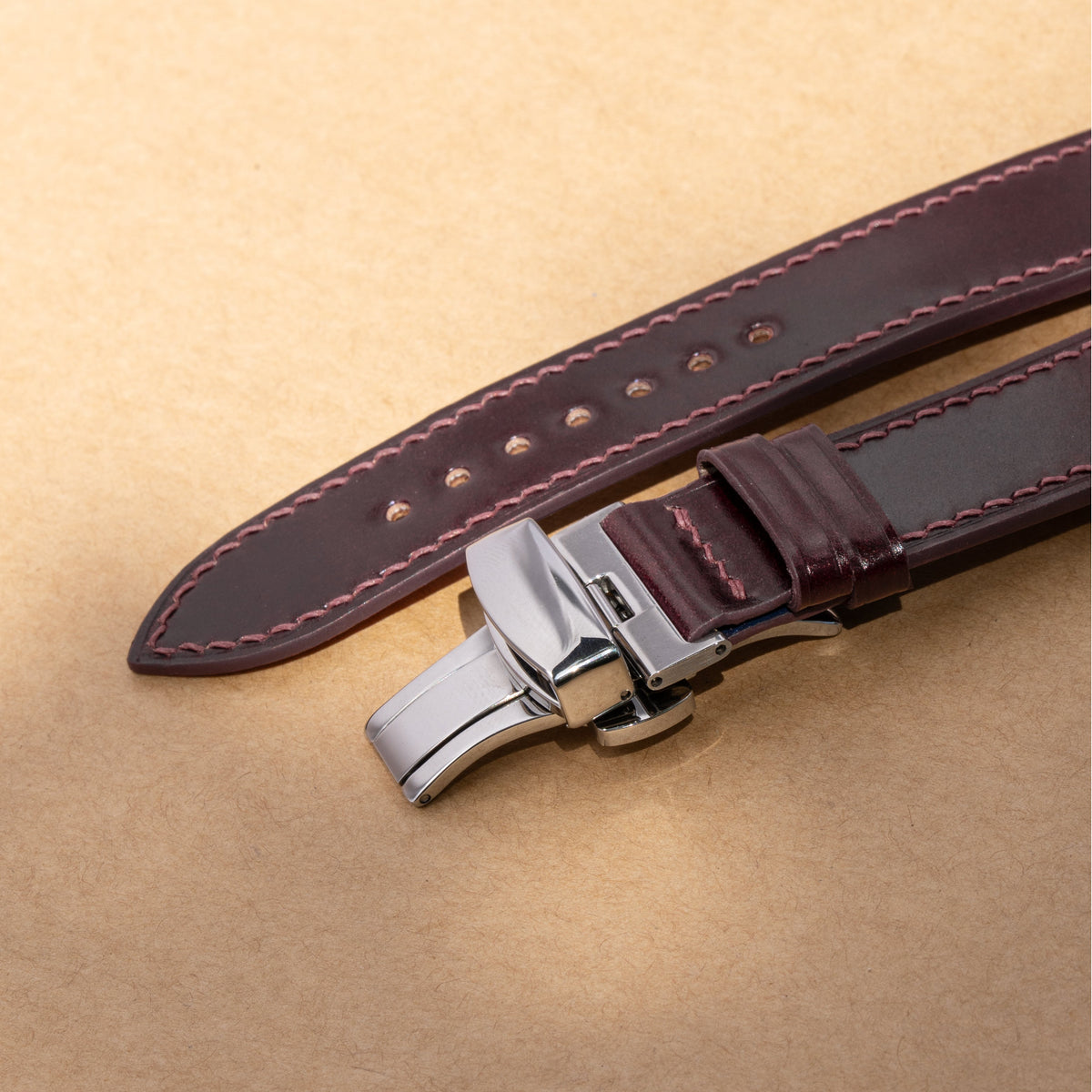
Butterfly Clasp vs Pin Buckle: Which Suits Your Leather Strap?
A pin buckle, also called a tang buckle, is the classic closure on a leather strap: a metal frame with a pin that passes through one of the holes, while the tail tucks into the keepers. A butterfly clasp is a type of deployant (or deployment) clasp, a folding metal clasp that opens to let the watch slip over your hand and closes at the same point every time. A pin buckle is smaller and easier to adjust; a deployant typically means less handling of the leather.
Below we compare wear, comfort, sizing and looks, so you can choose the right watch strap clasp for the way you wear it. Every Cernir strap comes with a stainless steel pin buckle as standard. You can order a stainless steel butterfly clasp instead, in even widths from 10mm to 22mm.
How a pin buckle and a deployant clasp work
With a pin buckle, the long piece of the strap passes through the buckle frame, the pin drops into a hole and the remaining tail slides under one or two keepers.
A deployant clasp replaces the buckle with a hinged metal mechanism. The strap is set to your size once, and from then on the clasp folds open and shut at the same point, so the leather is not threaded through a frame each day. Designs vary. Some keep the look of a pin buckle on top with a folding blade underneath. A butterfly clasp has two blades that fold out symmetrically from the centre, and it is often opened with a push button on each side.
Deployant and deployment clasp describe the same idea, and folding clasp is often used for both. A butterfly clasp is one kind, so a leather watch strap with a deployment clasp may or may not have the butterfly style.

This short video shows a butterfly clasp being fitted to an Epsom strap in our workshop, along with the holes for the quick-release spring bars.
How each closure wears the leather
On a strap with a pin buckle, most of the wear is concentrated in a small area. The hole you use every day takes the pull of the pin, and the leather beside it bends around the buckle frame each time you fasten and unfasten. Over time that hole commonly stretches a little and a crease forms at the fold. The tail also slides in and out of the keepers, which may wear its surface and edges near the tip.
A deployant changes that pattern. Once the clasp is set, the strap is not pulled through a buckle when you take the watch off, so the holes and the tail are typically handled far less. The leather still flexes where it meets the clasp, and the metal blades rest against the lining, so some wear still happens, in different places.
With either closure, our guide to caring for a leather watch strap covers cleaning and drying.
Comfort on the wrist
A pin buckle is the smaller of the two. It is a single frame on the underside of the wrist, and because most straps narrow towards the buckle end, there is less leather and metal in that spot.
A deployant clasp puts more metal under the wrist, since the folded blades lie flat against it. On a slim wrist it can feel bulkier, and its edges can press if the strap is set too tight. A butterfly clasp joins the two ends of the strap in the middle, so it usually sits centred on the underside of the wrist.
Security is the other difference. When you remove a watch on a pin buckle, the strap opens fully and the watch can slip if you are not holding it. A deployant stays a closed loop while you take it off and put it on, so the watch is less likely to drop.
Sizing: a row of holes or a fixed length
A pin buckle strap is adjusted on the wrist. If your wrist swells in the heat, you move the pin along one hole. That makes it forgiving if you are between sizes.
A deployant is set to a fixed length. The strap is fitted to the clasp at a size that suits your wrist with the clasp closed, and changing it later usually means moving the clasp to a different hole or set of holes, or using a strap of a different length. Clasp designs differ, so treat this as general guidance. On a Cernir strap you choose the length in the usual way: our size guide applies to straps ordered with the butterfly clasp too. Like a buckle, a clasp also has to match the width of the strap where it attaches, which is set by the strap's taper.
Whichever closure you choose, start with your lug width and wrist size. Our watch strap sizing guide explains the S, M and L lengths, and the strap length finder works from your wrist circumference and your watch's lug-to-lug length. Either closure fixes to the strap, not to the watch, so fitting the strap to the case works the same way; our guide on how to change a watch strap shows the steps.
How each one looks
This part is a matter of taste, and since both closures sit under the wrist, the difference shows mostly when you turn your wrist. A pin buckle shows a frame, the hole in use and a tail held by the keepers. A butterfly clasp shows a smooth metal section and no loose tail.
Visually, we find a pin buckle looks at home on almost any leather strap and suits casual, field and sports watches. Its finish is a simple way to echo the case: the stainless steel pin buckle on Cernir straps comes in silver, yellow gold, rose gold or black, all at the same price. Our butterfly clasp is also stainless steel. A butterfly clasp gives a cleaner, more formal line under the wrist, and to our eye it pairs well with dress watches.

Butterfly clasp vs pin buckle: which should you choose?
- Choose a pin buckle if you like to adjust the fit through the day, your wrist size changes noticeably with heat or activity, you prefer the least metal under your wrist, or you want the traditional look.
- Choose a butterfly clasp if you want the holes and tail handled as little as possible, you prefer a closure that stays shut as a loop when the watch comes off, or you like a cleaner look under the wrist, and you are confident about your size.
If you are unsure, the pin buckle is the more forgiving start. Every Cernir strap is made to order, and in our custom strap builder you can set the lug width, buckle width, thickness and length to suit your watch.
Frequently asked questions
Is a deployant clasp better for a leather strap?
It depends on what you value. A deployant typically means less wear at the holes and tail; a pin buckle is smaller under the wrist and easier to adjust.
What is the difference between a deployant and a butterfly clasp?
A butterfly clasp is one type of deployant. It has two blades that fold out from the centre like wings, and it is often opened with push buttons on both sides. Other deployants fold to one side.
Can I order a Cernir strap with a butterfly clasp?
Yes. Choose the butterfly clasp as an add-on when you order. It is stainless steel and comes in even widths from 10mm to 22mm. A strap ordered with the clasp does not also come with a pin buckle, because the strap ends are made differently for each closure. Without the clasp, every strap includes a stainless steel pin buckle in silver, yellow gold, rose gold or black.
Does a butterfly clasp need a different strap length?
Not on a Cernir strap. Choose your length with our sizing guide as you would for a pin buckle strap, and contact us if you are between sizes.


Leave a comment
This site is protected by hCaptcha and the hCaptcha Privacy Policy and Terms of Service apply.