


Edge Painting on Leather Watch Straps
Edge paint is a coloured coating applied to the cut sides of a leather watch strap. It covers the fibres exposed when the leather was cut, gives the layers of the strap one clean outline and leaves a smooth surface along the side. On a well-finished strap it should read as part of the strap rather than a separate layer sitting on top.
Paint is one of several ways to finish a strap edge. Some straps have the outer leather folded over the edge, some are burnished and some are left raw. Below we explain how these finishes typically look and wear, how we finish edges at our Da Nang workshop, and how to look after a painted edge.
What edge finishing does on a watch strap
When leather is cut, the edge shows its inner fibres. Left untreated, those fibres can fuzz, pick up dirt and take up moisture more readily than a finished surface. The edges of a watch strap rub against cuffs, desks and the keeper, so they tend to see more friction than the face of the strap.
Many leather straps are also built in layers. Ours use four: the outer leather, a reinforcement layer that holds the shape and limits stretching, extra strength at the spring bars, and a lining of soft Zermatt calfskin from Tanneries Haas. On our cut-edge straps, the edge finish covers all of those layers at once, so that from the side the strap reads as one piece.
A good edge finish does three jobs. It covers the cut fibres, it ties the layers together visually and it sets the outline of the strap. Visually, we find that thin, even edges make a strap look sharper, while thick or uneven edges can make it look heavier than it is.
Painted, folded, burnished and raw edges compared
Painted edges
For a painted edge, the cut side is typically sanded smooth, sealed and then coated with edge paint, often in several thin coats with light sanding in between. Edge paints are generally made to flex with the leather. The colour can match the leather or contrast with it, and paint can be used on a wide range of leathers, including many that are not well suited to burnishing.
Edge paint is often confused with edge dye. Edge dye typically soaks into the fibres and colours them, while edge paint builds a layered coating on the surface. In practice a finishing system may combine several products, such as a sealer, a dye and a paint, so the line between them is not always sharp.
The trade-off is that paint is a surface coating. With flexing and friction it may wear thin or show fine cracks where the strap bends most.
Folded edges (rembordé)
On a folded or rembordé edge, the outer leather is thinned and wrapped around the side of the strap, so no cut edge is on show. The result is a rounded profile with the grain running continuously over the edge. Folded edges are often used on padded straps and softer leathers, and they feel smooth against the wrist.
Folding typically takes more time than cutting and painting. Visually, a rounded edge looks softer and more traditional than a crisp painted one, and which suits your watch is mostly a matter of taste.
Burnished and raw edges
A burnished edge is sanded and then rubbed, often with water or a burnishing compound, until the fibres compress into a smooth, slightly glossy finish. Burnishing typically suits firm vegetable-tanned leather and is less suited to many soft or chrome-tanned leathers. On a layered strap, the separate layers may stay visible from the side.
A raw edge is simply cut and left unfinished. It gives a rugged, casual look, but the fibres stay exposed and tend to fuzz and darken with wear.
| Edge finish | Look | Strengths | Trade-offs |
|---|---|---|---|
| Painted | Crisp, even line; colour-matched or contrasting | Can be used on many leathers; covers the layers | A surface coating that may wear at flex points |
| Folded (rembordé) | Rounded, no visible cut | Smooth feel; grain runs over the edge | Typically slower to make; a softer look |
| Burnished | Smooth, slightly glossy | No separate coating on top | Typically suits firm vegetable-tanned leather; layers may show |
| Raw | Rugged, casual | Simple | Fibres stay exposed and tend to fuzz |
How Cernir finishes its strap edges
Edge finishing is one of the 18 steps in our handmade process, which you can follow on our crafting process page. On our cut-edge straps, each edge is sanded, sealed and painted, and the finish is built up in several coats. In our experience, thin coats sit closer to the leather and follow the shape of the strap more neatly than one heavy layer.
Not all of our straps have painted edges: Slim, Padded, Side-Stitch and Hybrid Rally Pilot straps have them as standard, while our rembordé straps have folded edges. Folded edges can be ordered in Togo, Epsom, Alran Chevre Sully and alligator, and our guide to rembordé watch straps explains how they are made and how to order one. The Taupe Togo Leather Padded Folded Edge Watch Strap is made in the rembordé style: the outer Togo calfskin is folded around the edges instead of being cut and painted. We find this suits the pebbled leather, which wraps the wrist more easily than Epsom, and the cushioned padded shape.

Edges and stitching work together. On our stitched straps the stitch line runs parallel to the edge, so a neat, even edge helps the hand saddle stitching look straight, while an uneven edge draws the eye to every small wobble in the seam.
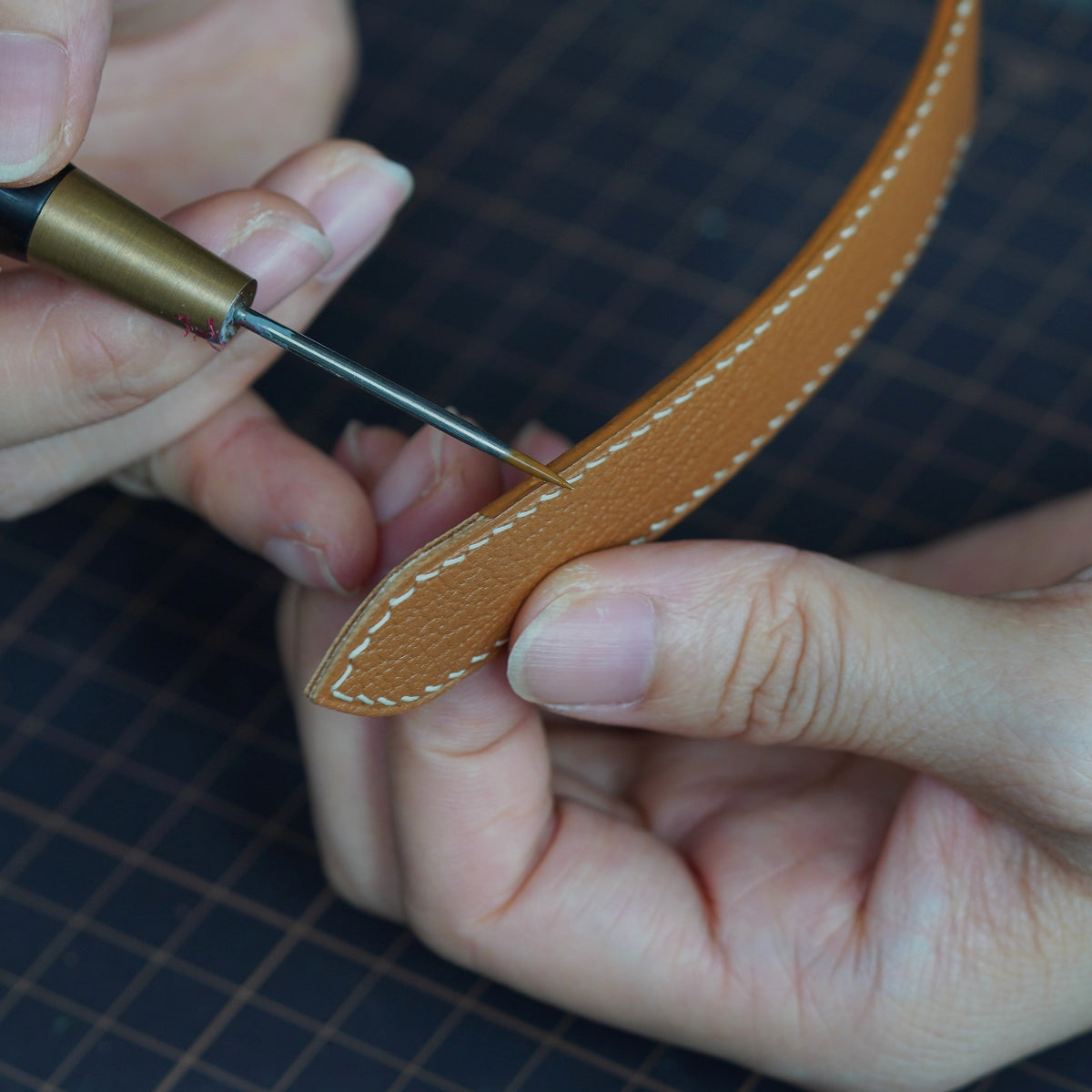
A short clip of edge painting at our bench:
What to expect from a painted edge over time
A new painted edge should feel smooth and look even along its length, with no gaps where the layers meet. Like the leather surface, it will pick up small marks with use.
The areas that work hardest are usually where the strap bends most: around the buckle holes, under the keeper and close to the lugs. After a long period of regular wear, the paint there may wear thin or show fine cracks. This is a normal sign of wear for a painted edge and does not by itself mean the leather underneath has failed.
Heat, frequent moisture and contact with solvents may shorten the life of an edge finish. How soon an edge shows wear depends on the leather, the climate, how tightly the strap is worn and how often it is rotated with others.
Whether a worn edge can be refinished depends on the strap and the extent of the wear. If an edge on your Cernir strap shows wear, send us a photo through our contact page and we will tell you what we think.
How to care for strap edges
- The strap is not waterproof. Wipe off moisture promptly, edges included, and let it dry naturally at room temperature.
- Never soak the strap, and do not dry it with a hair dryer, direct heat or strong sun.
- Keep alcohol wipes, hand sanitiser, solvents, perfume and household cleaners away from the strap, as they may damage the edge finish and the leather.
- Avoid folding the strap sharply when it is off the wrist, and do not fasten it tighter than you need to.
- Rotate between straps if you can, so moisture can dissipate between wears.
If you are still choosing a leather, our guide to choosing a watch strap leather compares how the leathers we use look, feel and change with wear.
Frequently asked questions
Is edge paint the same as edge dye?
Not quite. Edge dye typically soaks into the fibres, while edge paint is a layered coating on the sanded edge. Many finishing systems combine several products, so a finished edge may involve both.
Does edge paint crack?
It can, over time, at the points where the strap bends most. Careful preparation and thin coats help the finish follow the leather, and keeping the strap away from heat and solvents helps too.
Is a folded edge better than a painted edge?
Neither is better in every case. A folded edge has no cut side on show and feels smooth, while a painted edge gives a crisper outline and can be used on a wider range of leathers. It mostly comes down to the look you want.
Can a worn strap edge be repainted?
Sometimes. It depends on the strap, the leather and how far the wear has gone, and it is careful work for someone experienced with leather edges. For a Cernir strap, send us a photo first.


Leave a comment
This site is protected by hCaptcha and the hCaptcha Privacy Policy and Terms of Service apply.